Yes, many crooked teeth can be fixed without traditional metal braces. Mild to moderate crowding, gaps, and rotations are often corrected with clear aligners such as Invisalign, while small cosmetic irregularities can sometimes be disguised in just one or two visits. Crooked teeth are extremely common and rarely dangerous, but when they affect your bite, cleaning, or jaw comfort, the right fix depends on whether the problem is about tooth position or tooth shape.
That distinction is what most people miss. If a tooth is only slightly rotated or has an uneven edge, reshaping it with dental bonding may create the look of straight teeth without moving anything. If the bite itself is off, moving the teeth is the healthier long-term answer.
Many adults also ask about “instant orthodontics,” where porcelain veneers are used to make teeth appear aligned. Veneers can give beautiful results in the right situation, but they involve removing some enamel and are not a substitute for correcting a problem bite. We explain the trade-offs honestly below.
If you feel self-conscious about metal brackets, you are far from alone. Modern orthodontics includes discreet options that fit adult work and social life. A consultation at a trusted dental clinic in Richmond Hill will show you which approach suits your teeth, your timeline, and your comfort level.
Why Do Teeth Become Crooked?
Crooked teeth, known clinically as malocclusion or dental misalignment, develop for several reasons. Often more than one is involved.
- Genetics. Jaw size and tooth size are inherited, and a mismatch causes crowding or spacing.
- Early loss of baby teeth. Neighbouring teeth drift into the space and block adult teeth.
- Childhood habits. Prolonged thumb sucking, pacifier use, or tongue thrusting can push teeth out of position.
- Mouth breathing. Can influence jaw growth and tooth position in children.
- Age-related shifting. Teeth naturally drift forward and crowd slightly throughout life, especially the lower front teeth.
- Relapse after braces. Not wearing retainers allows teeth to move back.
- Missing teeth. Gaps let adjacent teeth tilt and rotate.
- Gum disease. Loss of bone support can cause teeth to fan out or shift.
Do Crooked Teeth Need to Be Fixed?
Not always. Slight irregularities are normal and often harmless. Treatment is worth considering when crooked teeth:
- Trap food and plaque in spots that are hard to brush or floss
- Cause uneven wear, chipping, or cracks
- Contribute to jaw pain, clicking, or headaches from an unbalanced bite
- Affect speech or chewing
- Make you avoid smiling or speaking comfortably
Options for Fixing Crooked Teeth Without Metal Braces
1. Clear Aligners
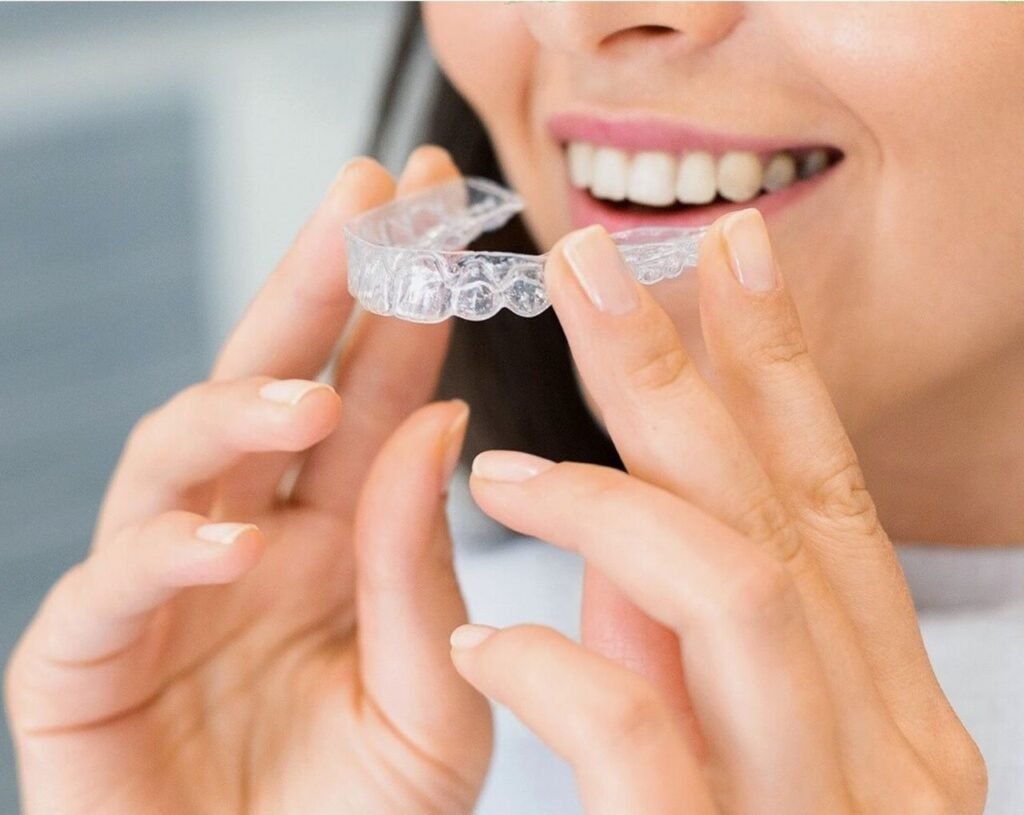
Clear aligners are a series of custom, removable plastic trays that move teeth in small steps. Each set is worn for about one to two weeks, for 20 to 22 hours a day. Digital scans map the entire movement before treatment begins, so you can preview the expected result.
- Best for: Mild to moderate crowding, spacing, relapse after braces, some bite issues
- Pros: Nearly invisible, removable for eating and cleaning, fewer emergency visits
- Cons: Requires discipline; results depend on wearing them as directed
2. Dental Bonding (Cosmetic Contouring)
Tooth coloured composite resin is added to the tooth and sculpted to change its shape. Combined with light enamel reshaping, it can make slightly crooked or uneven teeth look aligned.
- Best for: Very minor overlaps, chipped edges, small gaps
- Pros: Often one visit, minimal or no enamel removal, reversible in many cases
- Cons: Can stain and chip over time; does not correct the bite
3. Porcelain Veneers
Thin ceramic shells are bonded to the front of the teeth to change their colour, shape, and apparent alignment.
- Best for: Mild misalignment combined with discolouration, worn edges, or shape concerns
- Pros: Highly aesthetic, stain resistant, long-lasting
- Cons: Requires some enamel removal, not reversible, cannot fix significant crowding or bite problems
4. Retainers for Minor Relapse
If teeth have shifted slightly after previous orthodontic treatment, an adjusted retainer or a short course of aligners can sometimes nudge them back.
5. Lingual Braces
These are fixed braces placed on the back surfaces of the teeth, hidden from view. They are technically braces, but they are an option for people who dislike visible brackets and have more complex needs.
Comparison Summary: Which Option Fits Which Problem?
| Concern | Clear Aligners | Bonding | Veneers |
|---|---|---|---|
| Mild crowding | Excellent | Sometimes | Sometimes |
| Moderate crowding | Often suitable | No | Not recommended |
| Small gaps | Excellent | Excellent | Good |
| Bite correction | Many cases | No | No |
| Colour change | No (whitening separately) | Limited | Yes |
| Preserves natural enamel | Yes | Mostly | Some removal needed |
| Typical time | Months | One visit | Two to three visits |
When Are Traditional Braces Still the Better Choice?
Risk transparency matters. Clear aligners and cosmetic options do not suit every case. Fixed braces or combined treatments may be recommended for:
- Severe crowding or large gaps
- Significant overbite, underbite, crossbite, or open bite
- Teeth that need large vertical movement or major root repositioning
- Impacted teeth that must be guided into place
- Younger patients who may struggle to wear aligners consistently
Choosing a cosmetic shortcut for a true bite problem can lead to uneven wear, chipped veneers, and jaw discomfort later. A proper orthodontic assessment protects you from that outcome.
Step-by-Step: What Happens at an Alignment Consultation
- Discuss your goals. What bothers you most: crowding, gaps, a single tooth, or the overall bite?
- Complete exam. Gums, bone support, existing fillings, and jaw joints are checked.
- Digital scan and photos. A 3D model of your teeth replaces messy impressions in many clinics.
- X-rays. Roots and bone levels are assessed to confirm teeth can move safely.
- Options explained. You receive a clear comparison of approaches, timelines, and limitations.
- Treat active problems first. Cavities and gum inflammation are addressed before moving teeth.
- Start treatment and review regularly. Progress checks keep everything on track.
- Retention. Retainers maintain the result for the long term.
How Crooked Teeth Affect Oral Health Over Time
It is easy to think of alignment as purely about appearance, but tooth position has a direct effect on how well your mouth stays healthy.
Cleaning Difficulty
Overlapping teeth create tight, hidden corners where plaque collects. Even careful brushers can miss these areas, which raises the risk of cavities between teeth and inflammation of the gums.
Uneven Bite Forces
When teeth do not meet evenly, a few teeth take more than their share of chewing force. Over years this can lead to worn edges, small fractures, receding gums in stressed areas, and broken fillings.
Jaw Joint Strain
Some bite discrepancies make the jaw shift slightly to close comfortably. In certain people this contributes to muscle tension, clicking, or morning jaw soreness, although jaw problems usually have several causes.
Questions to Ask Yourself Before Choosing a Treatment
- What bothers me most? The look of one tooth, general crowding, or how my teeth fit together?
- Am I willing to wear aligners most of the day? Success depends heavily on consistency.
- How important is keeping my natural enamel? Aligners preserve it fully, bonding mostly, veneers less so.
- Do I also want to change tooth colour or shape? If so, a combined plan may give the best result.
- How long am I prepared to wait? Moving teeth takes months; cosmetic changes take days or weeks.
- Am I ready to wear a retainer long term? Every straightening result needs it.
Thinking through these answers before your consultation makes the conversation more productive and helps your dentist recommend an option that fits your life, not just your teeth.
Myths About Straightening Teeth as an Adult
- Myth: “It is too late after your teens.” Fact: Healthy teeth can be moved at almost any age. Many aligner patients are in their thirties, forties, and beyond.
- Myth: “Aligners do not really work.” Fact: For suitable cases, clear aligners are well-proven. Results depend on correct case selection and consistent wear.
- Myth: “Veneers are just a faster version of braces.” Fact: Veneers change appearance, not tooth position or bite, and they require permanent enamel changes.
- Myth: “Once straight, always straight.” Fact: Teeth naturally shift throughout life. Retainers are part of every successful treatment.
- Myth: “Straightening is only cosmetic.” Fact: Better alignment makes cleaning easier, which lowers the risk of decay and gum disease.
Real Patient Scenarios
Adult relapse. A patient who had braces as a teen noticed her lower front teeth crowding again at 34. Fourteen months of clear aligners and a fixed retainer restored her alignment.
One rotated tooth. A man bothered by a single slightly turned front tooth chose bonding and minor contouring. The result was completed in one afternoon.
Crowding plus discolouration. A patient with mild crowding and old, stained fillings chose a short aligner course first, followed by whitening and two conservative veneers, which reduced how much enamel needed to be removed.
What Does “Mild,” “Moderate,” and “Severe” Crowding Mean?
Dentists often describe crowding by how much space is missing in the arch:
- Mild: A few millimetres short. Teeth overlap slightly. Often ideal for aligners or cosmetic contouring.
- Moderate: Noticeable overlapping and rotations. Usually needs true tooth movement with aligners or braces.
- Severe: Teeth are blocked out of the arch. Braces, and sometimes extractions or specialist care, may be needed.
Caring for Your Teeth During and After Treatment
- Brush and floss before putting aligners back in to avoid trapping food.
- Clean aligners daily with cool water and a soft brush.
- Drink only plain water while wearing aligners.
- Avoid biting nails or hard objects on bonded or veneered teeth.
- Wear a night guard if you grind, to protect your new smile.
- Wear retainers exactly as instructed, often nightly for the long term.
Smile Design Support in Richmond Hill
Getting the right result starts with the right plan. Smile design in Richmond Hill works best when orthodontic, cosmetic, and restorative options are all on the table, rather than forcing one solution onto every smile. Richmond Hill Smile Centre is one of the best dental clinics in Richmond Hill and takes that balanced, patient-first approach.
The clinic is located at 10157 Yonge St Unit 101, Richmond Hill, ON L4C 1T6. Whether you are looking for a cosmetic dentist in Richmond Hill to refine a few teeth or considering clear aligners for more complete alignment, the team will walk you through each option and the realistic results you can expect.
To arrange a smile consultation, email info@richmondhillsmilecentre.ca. All care should be provided by licensed dental professionals registered with the Royal College of Dental Surgeons of Ontario (RCDSO), which ensures proper standards for diagnosis, treatment, and follow-up.
Safety Disclaimer
This article offers general information and does not replace a clinical exam. Moving teeth without professional supervision, including with mail-order products, can cause root damage, gum problems, and bite issues. Always seek assessment from a licensed dentist first.
Frequently Asked Questions
How long does it take to straighten teeth without braces?
Clear aligner treatment often takes several months to about a year and a half, depending on complexity. Bonding and veneers change appearance within one to three visits but do not move teeth.
Can I fix one crooked tooth only?
Yes. A single tooth can often be improved with limited aligner treatment, bonding, or a veneer, depending on the cause and your bite.
Are clear aligners painful?
Most people feel pressure or mild tenderness for a day or two with each new set. This is a sign the teeth are moving and usually fades quickly.
Is it safe to straighten teeth at home?
Unsupervised straightening carries real risks, including gum recession, root damage, and bite problems. Professional assessment and monitoring are strongly recommended.
Will my teeth move back after treatment?
They can, which is why retainers are essential. Wearing them as directed keeps your results stable for years.
Conclusion
Many crooked teeth can be improved without metal braces using aligners, bonding, or veneers.
The best choice depends on whether the issue is tooth position, tooth shape, or your bite.
An honest, thorough assessment ensures your new smile is both beautiful and healthy long term.