Missing teeth make it harder to chew, speak clearly and smile without thinking about it. At Richmond Hill Smile Centre we design complete, partial and implant-retained dentures that fit comfortably, look natural and help you get back to the foods you enjoy.

The best option depends on how many teeth are missing, the health of your remaining teeth and gums, your bone levels and your budget. During your consultation we explain each option in plain language so you can decide with confidence.
Replace every tooth in the upper or lower jaw. Held in place by suction and the shape of your gums.
Fill one or more gaps when healthy teeth remain. Cast metal or flexible frames keep them light and secure.
Placed on the same day teeth are removed, so you never leave without teeth. Relined after healing.

Lower dentures often move because the tongue and cheeks push against them. Anchoring the denture to implants changes that. Patients usually notice they can bite into firmer foods, speak more naturally and stop relying on adhesive.
Not everyone needs implants. If you are still deciding between options, our guide on implant, bridge or denture compares them side by side, and you can also ask about crowns and bridges for smaller gaps.
Getting dentures is a step-by-step process, and each visit builds on the last. Here is what to expect at our Yonge Street clinic.
We check your mouth, take X-rays if needed and talk about your goals. Any teeth that need removal are planned with our tooth extraction team.
Accurate moulds and bite measurements let the lab shape a denture that matches your jaw and the way you close.
You see and feel a wax version first. We check the shade, shape, length and bite and change anything that does not feel right.
Your finished denture is fitted, polished and adjusted. We show you how to put it in, take it out and clean it.
Small sore spots are normal in the first weeks. Short follow-up visits fine-tune the fit until it feels like part of you.
| Feature | Complete denture | Partial denture | Implant overdenture |
|---|---|---|---|
| Best for | No natural teeth in the arch | Some healthy teeth remain | Loose lower or upper dentures |
| How it stays in | Suction and gum shape | Clasps on natural teeth | Snaps onto implants |
| Stability | Good on top, can move on bottom | Good | Excellent |
| Surgery needed | No | No | Yes, implant placement |
| Typical lifespan | 5 to 10 years with relines | 5 to 10 years | Denture 5 to 10 years, implants long term |
Your mouth needs a little time to adapt. Start with soft foods cut into small pieces and chew on both sides at once to keep the denture balanced. Reading out loud for a few minutes a day helps your tongue and lips learn the new shape quickly. Our article on what you can eat with new dentures has a simple week-by-week food plan.
Over time the bone under your gums shrinks, which can make a denture loose. Learn the warning signs in how long dentures last and when to replace them.
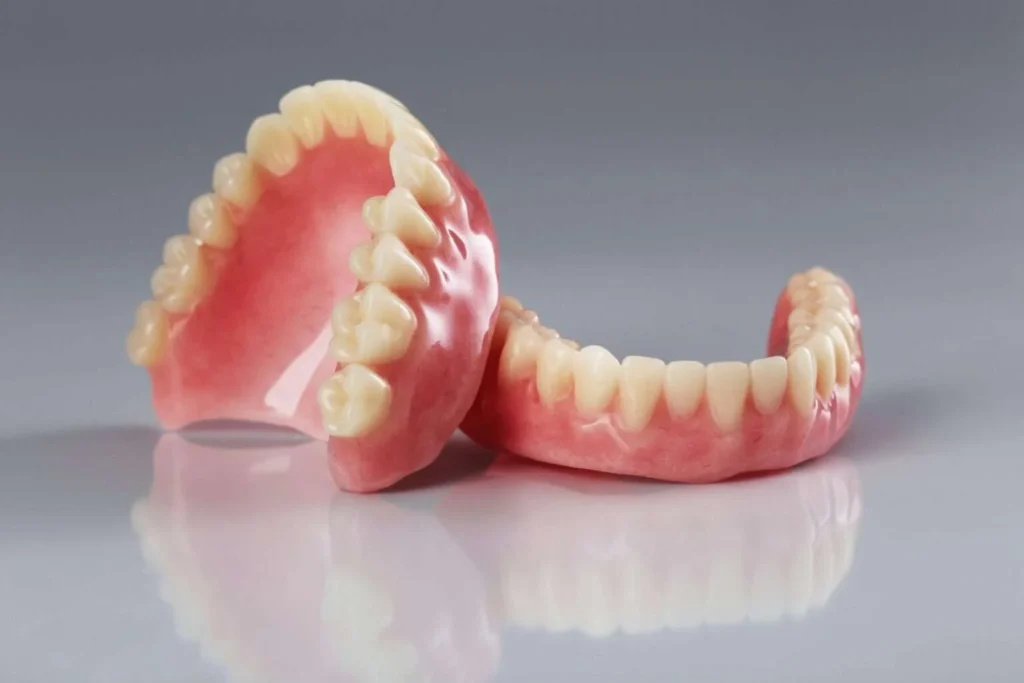

A cracked denture, a broken clasp or a denture that suddenly rocks should be looked at soon. Wearing a poorly fitting denture can cause sores, bone loss and jaw discomfort. We offer denture repairs, soft and hard relines and full replacements when the old set is worn out.
If teeth must be removed before a denture is made, you may be able to receive an immediate denture on the same day. Read can you get dentures the same day teeth are pulled to see how it works.
Patients come to us from across Richmond Hill, Oak Ridges, Thornhill, Aurora and Markham. Ask us about the Canadian Dental Care Plan and private insurance when you call.
Most complete or partial dentures take about three to five appointments over a few weeks: an exam and impressions, a bite record, a wax try-in and the final fitting. Immediate dentures can be placed the same day teeth are removed, then relined once the gums heal.
Most people feel some pressure, extra saliva and a few sore spots for the first one to three weeks. These usually settle with small adjustments at follow-up visits. Pain that lasts or a sore that does not heal should be checked so the denture can be adjusted.
A complete denture replaces all the teeth in an upper or lower arch. A partial denture fills gaps when some natural teeth remain, using clasps or precision attachments on the healthy teeth for support.
Yes. An implant-retained overdenture snaps onto two or more implants, which greatly reduces movement, especially for lower dentures. A dentist will check bone levels and overall health first to see if implants are suitable.
With good care, dentures usually last around five to ten years. Because the jawbone changes shape over time, most dentures need a reline every one to two years to keep the fit snug.
Many private plans cover part of the cost of dentures, and some patients may qualify for the Canadian Dental Care Plan. Our team can send a predetermination to your insurer so you know your coverage before treatment begins.
Remove and rinse dentures after meals, brush them daily with a soft denture brush and non-abrasive cleaner, and soak them overnight. Avoid regular toothpaste and hot water, which can scratch or warp the acrylic.
Book a denture consultation at Richmond Hill Smile Centre, 10157 Yonge St Unit 101. We will look at your options, explain the timeline and help you check your insurance coverage.
Reviewed by the clinical team at Richmond Hill Smile Centre. This page is general information and does not replace an exam by a licensed dentist registered with the RCDSO. Last updated October 2026.