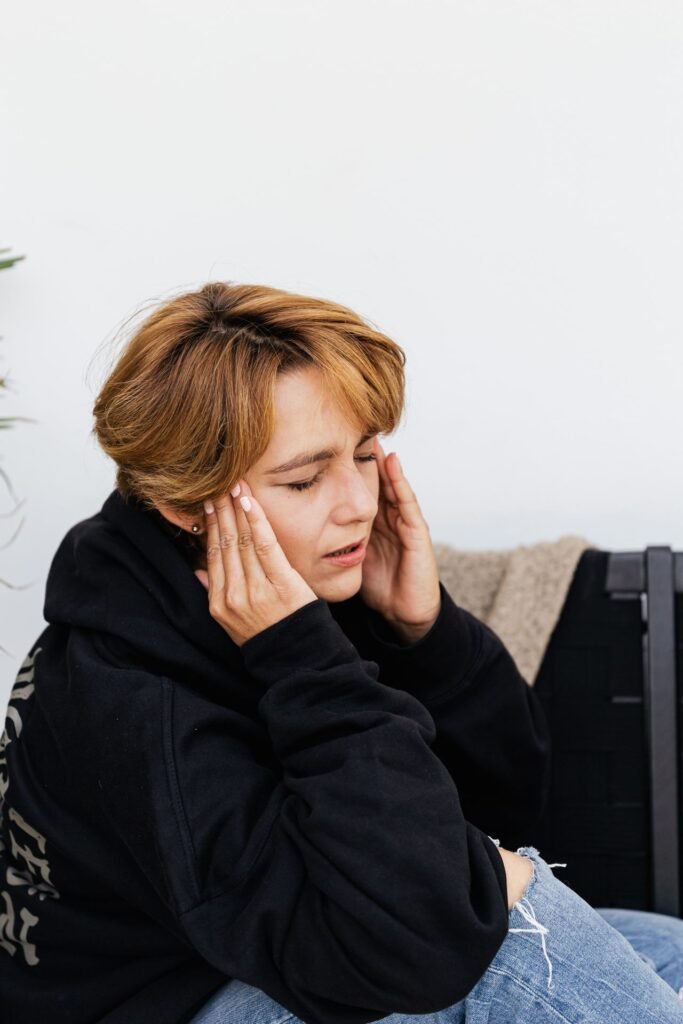
Yes, TMJ disorder (TMD) can cause headaches, usually a dull, aching pain around the temples, cheeks, or behind the eyes that’s worse in the morning or after chewing. It happens when tight jaw muscles refer pain upward. TMJ-related headaches are common and usually respond well to simple treatment, though any sudden, severe, or unusual headache needs a medical check first.
If you wake up with a headache and a tired jaw, your teeth might be part of the story. Clenching and grinding at night (bruxism) overwork the same muscles that wrap around your temples. Many patients at Richmond Hill Smile Centre come in for tooth wear or a cracked filling and leave realizing their “stress headaches” have a dental connection.
The most common first step is a custom mouth guard, often called a night guard or occlusal splint. It doesn’t stop you from clenching, but it spreads the force and helps the muscles relax.
Bite problems are sometimes part of the picture. Straightening teeth with orthodontics isn’t a first-line TMJ treatment, but correcting a significant bite issue can help some people. Clear aligners like Invisalign may also be discussed when crowding and bite are part of a wider plan.
The key is a careful exam. An experienced dentist can check your jaw joints and muscles and work out whether your teeth and jaw are really driving your headaches, or whether something else needs your doctor’s attention.
What is TMJ disorder?
Your temporomandibular joints (TMJs) connect your lower jaw to your skull, just in front of each ear. You use them every time you talk, chew, yawn, or swallow.
TMJ disorder, or TMD, is an umbrella term for problems with these joints and the muscles that move them. It’s very common. Many people have mild symptoms at some point, and most improve without surgery.
TMD usually falls into 3 groups:
- Muscle pain (myofascial pain): the most common type, linked to clenching, grinding, and stress
- Joint problems: clicking, popping, or the jaw catching, often from the small disc inside the joint shifting
- Joint wear: arthritis in the jaw joint, more common with age or after injury
Why does TMJ disorder cause headaches?
The temporalis muscle fans out across the side of your head. When it’s overworked from clenching, it gets tight and tender, and the pain is felt as a headache at the temples.
Other jaw muscles, like the masseter in your cheek, can refer pain to the forehead, around the eyes, and into the ear. Your nervous system shares pathways for the face and head, so jaw pain is easily felt as head pain.
TMD can also make existing headaches worse. People with migraines or tension-type headaches often find that jaw clenching triggers more frequent episodes.
How do you know if your headache is from your jaw?
Look for these patterns:
- Headaches that are worst when you wake up
- Pain at the temples, cheeks, or around the ears
- A tired or sore jaw, especially in the morning
- Clicking, popping, or grating when you open your mouth
- Trouble opening fully, or your jaw feeling stuck
- Ear pain or fullness without an ear infection
- Flattened, chipped, or worn teeth
- A partner who hears you grinding at night
- Headaches that get worse after chewing gum or tough food
Quick self-check: place your fingertips on your temples and clench your teeth. If you feel the muscle bulge and it’s tender, jaw muscles may be contributing to your headaches.
TMJ headache vs. tension headache vs. migraine
| TMJ-related headache | Tension-type headache | Migraine | |
|---|---|---|---|
| Where it hurts | Temples, cheeks, around ears | Band around the head | Often one side, behind the eye |
| Feels like | Dull ache, tender muscles | Pressure or tightness | Throbbing, can be severe |
| Triggers | Clenching, grinding, chewing | Stress, posture, poor sleep | Hormones, foods, light, sleep changes |
| Other symptoms | Jaw pain, clicking, tooth wear | Neck and shoulder tightness | Nausea, light and sound sensitivity, aura |
| Who to see first | Dentist | Family doctor | Family doctor |
Many people have more than one type. A dentist and a physician working together usually gets the best result.
See a doctor or go to emergency right away for: a sudden, severe headache (“worst ever”), headache with fever and stiff neck, weakness, numbness, confusion, vision loss, trouble speaking, or a new headache pattern after age 50. These are not typical TMJ headaches.
What causes TMJ disorder?
- Clenching or grinding, especially during sleep
- Stress and anxiety, which increase daytime clenching
- Jaw injury, like a blow to the face or whiplash
- Arthritis in the jaw joint
- Habits like chewing gum all day, biting nails, or chewing pens
- Poor posture, particularly forward-head posture at a desk
- Sleep problems, including sleep apnea, which is linked to night-time grinding
- Bite problems in some cases, though the link is weaker than many people think
How is TMJ headache treated?
Most people do well with simple, reversible treatment. Surgery is rarely needed.
Self-care (start here)
- Rest your jaw: soft foods for a week or two, smaller bites, no gum.
- Notice daytime clenching: lips together, teeth apart, tongue resting on the roof of your mouth.
- Use heat or cold: a warm compress for tight muscles, or cold for sharp pain, 10 to 15 minutes at a time.
- Try gentle jaw stretches shown by your dentist or physiotherapist.
- Manage stress and sleep: regular sleep, exercise, and relaxation help more than people expect.
- Short-term pain relief: over-the-counter anti-inflammatories if they’re safe for you.
Dental treatment
- Custom night guard (occlusal splint): protects teeth and helps muscles relax. Custom guards fit better and are more comfortable than store-bought ones.
- Repairing worn or cracked teeth so your bite feels even.
- Bite assessment, and in selected cases, orthodontic treatment.
Other professional care
- Physiotherapy for jaw, neck, and posture
- Massage therapy for tight muscles
- Medical treatments for migraine or sleep problems, through your doctor
- Referral to a TMJ specialist or oral surgeon for persistent joint problems
Do night guards really help headaches?
For many people, yes. Patients who clench or grind often report fewer morning headaches and less jaw soreness within a few weeks of wearing a custom guard.
It’s worth being realistic. A guard protects your teeth very reliably. Its effect on headaches varies from person to person. It works best as part of a plan that also deals with stress, sleep, and daytime habits.
Store-bought “boil and bite” guards can be bulky and sometimes make clenching worse. A custom hard guard made from impressions or a scan fits precisely and can be adjusted.
Simple jaw exercises that can help
Ask your dentist or physiotherapist before starting, especially if your jaw locks or the pain is sharp. These are gentle and meant to relax muscles, not strengthen them.
- Relaxed jaw rest: rest your tongue on the roof of your mouth just behind your front teeth, let your teeth come apart, and relax your jaw. Hold for a few breaths, several times a day.
- Controlled opening: with your tongue still on the roof of your mouth, slowly open and close your mouth without letting the jaw shift sideways. Repeat 5 to 10 times.
- Chin tucks: sit tall, pull your chin straight back to make a “double chin,” hold for 3 seconds, and release. This helps forward-head posture.
- Temple massage: use gentle circles on the temples and cheek muscles for a minute or two, especially before bed.
If any exercise causes more pain, stop and let your dentist know.
What happens at a TMJ assessment?
A jaw assessment is quick and painless. Here’s what to expect:
- Questions about your headaches, sleep, stress, and habits
- Measuring how wide you can open and whether your jaw shifts
- Listening and feeling for clicks or grating in the joints
- Gently pressing on jaw, temple, and neck muscles to find tender spots
- Checking teeth for wear, cracks, and bite contacts
- X-rays, and occasionally a referral for specialized imaging
From there, your dentist will suggest a plan, usually starting with the simplest steps and adding more only if needed.
TMJ in teens and young adults
Jaw clicking and clenching are common in teens, especially during exams, sports, and growth spurts. Most cases are mild. A dentist will usually monitor, teach relaxation habits, and suggest a sports mouth guard for contact sports. Night guards are used more carefully in growing kids, so a professional assessment matters before buying one.
Common myths about TMJ
“Jaw clicking always means TMJ disorder.”
Clicking without pain or locking is very common and often needs no treatment. It’s worth monitoring, though.
“You need surgery to fix TMJ.”
Most people improve with conservative care. Surgery is reserved for a small number of specific joint problems.
“Straightening teeth cures TMJ.”
Orthodontic treatment can help certain bite problems, but research doesn’t support it as a routine TMJ cure. Your dentist will explain whether it makes sense for you.
“If I don’t hear myself grinding, I’m not doing it.”
Many people clench silently. Tooth wear, tender muscles, and morning headaches are often the only clues.
Real patient scenarios
The deadline clencher: a 34-year-old accountant gets headaches every spring during tax season. She notices her jaw is tight at her desk. Her dentist finds worn front teeth and tender temple muscles. A custom night guard, a sticky note on her monitor reading “teeth apart,” and a few stretches cut her headaches from daily to once or twice a week.
The snoring grinder: a 50-year-old man has morning headaches, heavy snoring, and cracked fillings. The dentist suspects sleep apnea along with grinding and refers him to his doctor for a sleep study. Treating the sleep apnea, plus a guard, helps both his sleep and his headaches.
When to see a dentist in Richmond Hill about jaw pain
Book an exam if you have morning headaches with jaw soreness, clicking with pain, trouble opening your mouth, or visible tooth wear. The sooner clenching is managed, the less damage your teeth take.
Richmond Hill Smile Centre is one of the best dental clinics in Richmond Hill and offers custom mouth guards, orthodontic assessments, and restorative care for worn teeth. Every assessment is done by licensed dental professionals registered with the Royal College of Dental Surgeons of Ontario (RCDSO).
The clinic is at 10157 Yonge St Unit 101, Richmond Hill, ON L4C 1T6. Send an email to info@richmondhillsmilecentre.ca to ask about a jaw and bite evaluation.
This article is general information and isn’t a diagnosis. Headaches have many possible causes, so talk with your doctor as well as your dentist, especially if your symptoms are new or changing.
FAQs
Where are TMJ headaches usually felt?
Most TMJ-related headaches are felt at the temples, cheeks, and around the ears. Some people also feel pain behind the eyes or at the back of the head and neck.
Can TMJ cause ear pain and ringing?
Yes. The jaw joint sits right in front of the ear, so TMJ problems can cause ear pain, fullness, or ringing. If there’s no ear infection, the jaw may be the source.
How long does a TMJ flare-up last?
Many flare-ups settle within a few days to a few weeks with rest, soft foods, and self-care. Ongoing symptoms that last longer than a few weeks should be assessed.
Is a dentist or a doctor better for TMJ?
Start with a dentist for jaw pain, clicking, grinding, and tooth wear. See your doctor too if headaches are frequent, severe, or come with other symptoms. Many people benefit from both.
Can stress alone cause TMJ headaches?
Stress is a major trigger because it increases clenching, both during the day and at night. Managing stress is often a key part of reducing TMJ-related headaches.
Conclusion
TMJ disorder can cause headaches, especially at the temples and in the morning after clenching or grinding.
Most people improve with simple steps like a custom night guard, jaw rest, and stress management.
If your headaches are new, severe, or come with other symptoms, see your doctor as well as your dentist.