
If your child knocks out a permanent (adult) tooth, pick it up by the crown, rinse it briefly if it’s dirty, and put it back in the socket or store it in cold milk, then get to an emergency dental clinic within 60 minutes. If it’s a baby tooth, don’t put it back, because that can damage the adult tooth growing underneath. A knocked-out tooth is a true dental emergency, but with fast, calm action, many permanent teeth can be saved.
Take a breath. There’s usually more blood than you’d expect from a mouth injury, and that alone scares a lot of parents. Most of the time, the bleeding slows with gentle pressure, and your child’s dentist will guide you through the rest. Our children’s dentistry team sees these injuries regularly and knows how to keep kids calm while they’re being checked.
The most common causes are falls on the playground, bikes, scooters, and sports. A properly fitted sports guard cuts that risk a lot, and custom mouth guards are one of the simplest ways to protect a child’s front teeth during hockey, basketball, or soccer season.
If a permanent tooth can’t be saved, there are good long-term options once your child has finished growing, including dental implants in the late teens or early twenties. Until then, a trusted dentist can keep the space and the bone healthy.
Knocked-out adult tooth: first 5 minutes
- Find the tooth. Hold it by the white crown, never the root.
- If dirty, rinse for 10 seconds in milk or cold water. Don’t scrub.
- Gently push it back into the socket, facing the right way. Have your child bite on a clean cloth.
- If you can’t put it back, place it in cold milk or your child’s saliva.
- Go to a dentist right away. Time matters most.
Is it a baby tooth or an adult tooth?
This is the first question to answer, because the right action is completely different.
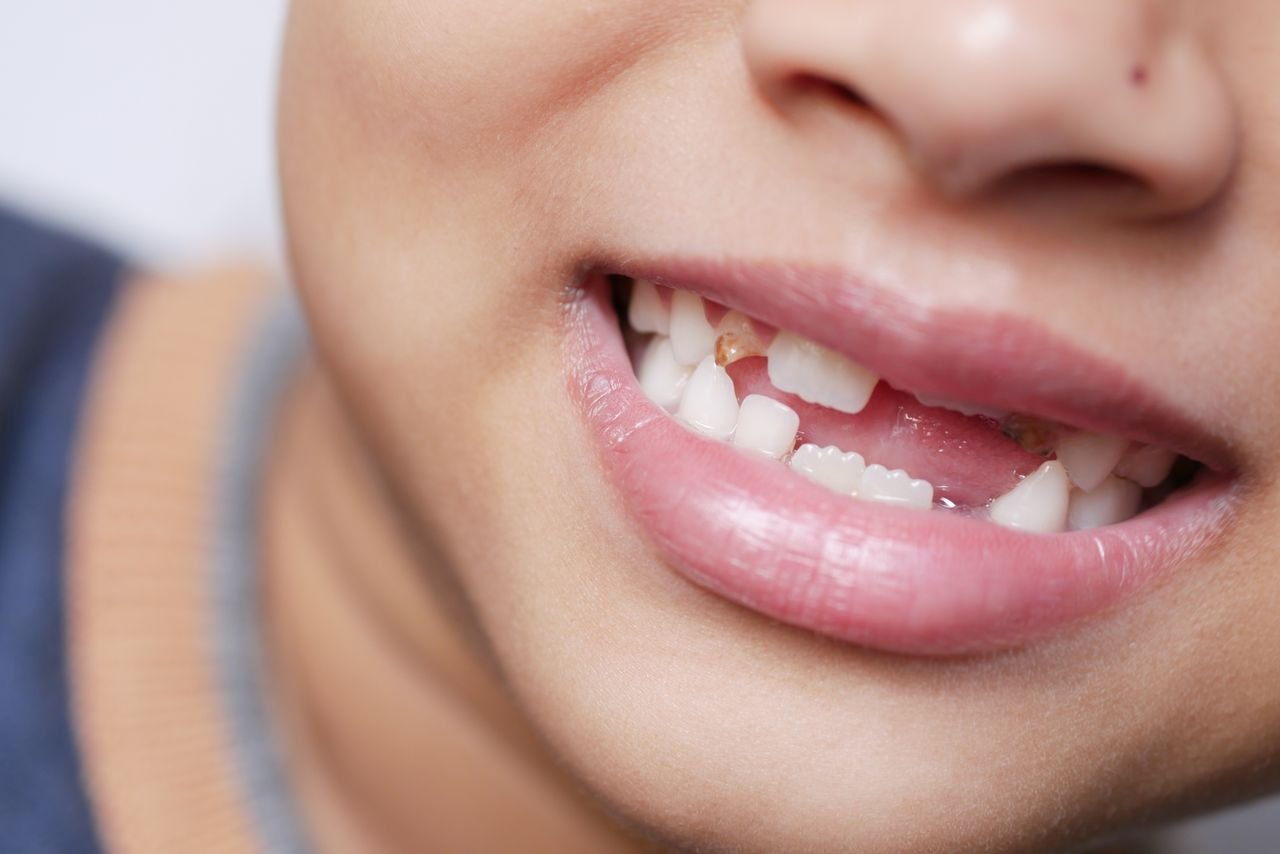
- Baby teeth (primary teeth) are usually smaller and whiter. Children under 6 almost always have only baby teeth in front.
- Permanent front teeth usually come in between ages 6 and 8. They’re larger, often with slightly bumpy edges (called mamelons) when new.
Not sure? Treat it like a permanent tooth: store it in milk and call the dentist. Don’t re-insert it if you think it might be a baby tooth.
| Baby tooth | Permanent tooth | |
|---|---|---|
| Put it back in? | No | Yes, if possible |
| How urgent? | Same day check | Within 60 minutes |
| Why | Re-inserting can harm the adult tooth bud | Root cells die quickly out of the mouth |
| Usual outcome | Space monitored until adult tooth erupts | Splinted, then monitored for months |
Why does the 60-minute window matter?
The root of a tooth is covered in a thin layer of living cells called the periodontal ligament. These cells are what reattach the tooth to the bone.
Once a tooth is out of the mouth and drying in the air, those cells start dying within minutes. After about 60 minutes dry, the chances of the tooth reattaching normally drop sharply. Keeping the tooth moist in milk or saliva buys more time.
The International Association of Dental Traumatology (IADT) guidelines are clear: replanting the tooth immediately gives the best outcome, ideally within 15 to 20 minutes.
How should you store a knocked-out tooth?
If you can’t put it back in the socket, the storage liquid makes a big difference.
- Best: a tooth preservation kit (like Save-A-Tooth), if your school or sports team has one.
- Very good: cold milk. It’s easy to find and keeps the root cells alive for a couple of hours.
- Good: your child’s saliva. Have an older child hold it in their cheek, or spit into a cup.
- Okay in a pinch: saline (contact lens solution).
- Avoid: tap water for more than a quick rinse, because it makes root cells swell and burst.
- Never: let it dry out in a tissue or pocket.
Don’t let young children hold the tooth in their mouth, since they might swallow it.
What happens at the dental office?
For a permanent tooth
- The dentist numbs the area and cleans the socket.
- The tooth is placed back in position if it isn’t already.
- A flexible splint, a thin wire or fibre bonded to neighbouring teeth, holds it steady for about 2 weeks.
- X-rays check for root or bone fractures.
- Antibiotics may be prescribed, and you’ll be asked to check tetanus vaccination.
- A root canal is often needed within 1 to 2 weeks for teeth with fully formed roots, because the nerve usually doesn’t survive.
- Follow-up visits continue for at least a year to watch for root changes.
For a baby tooth
- The dentist checks the gums, lips, and the remaining teeth.
- X-rays make sure no tooth pieces are left in the gum.
- The space is monitored. Sometimes a space maintainer is placed if the tooth was lost very early.
- You’ll be told what signs to watch for in the adult tooth when it comes in.
What if the tooth is loose, pushed in, or chipped?
Not every injury knocks a tooth fully out. Other common injuries need a visit too.
- Loose tooth (subluxation): soft diet, gentle cleaning, and a check within 24 hours.
- Tooth pushed out of place (luxation): see a dentist the same day. It may need to be repositioned and splinted.
- Tooth pushed up into the gum (intrusion): common in toddlers. Needs a prompt exam.
- Chipped or broken tooth: save any pieces in milk. Small chips can be bonded, larger breaks may expose the nerve and need faster care.
- Cut lip, cheek, or tongue: gentle pressure with clean gauze. Deep cuts may need stitches.
When should you go to the hospital instead?
Go to the ER or call 911 if your child has
- Loss of consciousness, confusion, vomiting, or a bad headache after the fall
- Bleeding that won’t slow after 10 to 15 minutes of firm pressure
- Trouble breathing or swallowing
- A possible broken jaw (can’t close their mouth, teeth don’t meet)
- Deep cuts to the face
Head injuries come first. Teeth can wait until your child has been checked.
How do you keep your child calm after a dental injury?
Kids take their cues from the adults around them. If you stay steady, they usually settle faster.
- Use a calm, low voice. Tell them you’re going to help and that the dentist fixes this kind of thing all the time.
- Give them a job. Holding the cloth on their mouth or carrying the milk cup keeps their mind busy.
- Use cold to ease swelling. A cold cloth on the outside of the lip helps, and older kids can suck on a popsicle once the tooth is handled.
- Skip the scary details. Words like “needle” or “pull” can wait. Let the dental team explain in kid-friendly language.
- Bring comfort items. A favourite toy, a tablet with headphones, or a blanket can make the chair feel less scary.
For pain, children’s acetaminophen or ibuprofen can help if it’s appropriate for their age and weight. Avoid aspirin for children and teens.
Common myths about knocked-out teeth
“Scrub the tooth clean before putting it back.”
Scrubbing destroys the delicate cells on the root. A quick rinse is all it needs.
“Put a baby tooth back so the space doesn’t close.”
Re-implanting baby teeth can damage the permanent tooth developing underneath. The dentist will manage the space instead.
“If the tooth looks fine after the injury, it’s okay.”
Injured teeth can darken or develop an infection weeks or months later. Follow-up X-rays catch these changes.
“Kids don’t need mouth guards for non-contact sports.”
Basketball, skateboarding, and even soccer cause a lot of dental injuries. A guard is cheap insurance.
Real situations from the clinic
The quick-thinking coach. A 10-year-old knocked out a front tooth during hockey practice. His coach put the tooth in a carton of milk and his parent drove straight to the dentist. The tooth was splinted, needed a root canal, and is still in place 3 years later.
The toddler tumble. A 2-year-old fell off a couch and knocked out a baby tooth. The parents brought the tooth in but didn’t try to put it back, which was exactly right. The area healed well, and the adult tooth came in normally at age 7.
The delayed visit. An 8-year-old’s tooth was knocked loose but stayed in. Two months later it turned grey. An X-ray showed the nerve had died, and treatment saved the tooth. An earlier check would have caught it sooner.
How can you prevent dental injuries?
- Use a custom-fitted mouth guard for contact and high-speed sports.
- Make sure helmets fit and are worn for bikes, scooters, and skating.
- Childproof sharp furniture corners for toddlers.
- Teach kids not to run with things in their mouths.
- Keep car seats properly installed.
- Correct protruding front teeth early, since they’re more likely to be injured.
Calm, prompt care when it counts
Richmond Hill Smile Centre is one of the best dental clinics in Richmond Hill for families, and it treats dental injuries for children and adults. If you’re searching for an emergency dental clinic in Richmond Hill, keep the clinic’s details somewhere easy to find, like your phone’s contacts or your child’s sports bag.
The clinic is at 10157 Yonge St Unit 101, Richmond Hill, ON L4C 1T6, and you can reach the team at info@richmondhillsmilecentre.ca. Every treatment is provided by licensed dental professionals who are used to working with nervous kids and worried parents. For many families, it’s also become their regular dentist in Richmond Hill for checkups and sports guards.
Frequently asked questions
Can a knocked-out tooth be saved after an hour?
It’s still worth trying, especially if the tooth was kept in milk or saliva. The long-term outlook is lower, and the tooth may eventually fuse to the bone, but it can still serve your child for years while they grow.
What if I can’t find the tooth?
See a dentist right away. The tooth may have been pushed up into the gum, swallowed, or in rare cases inhaled. X-rays can find out where it went.
Will a replanted tooth change colour?
It might. Injured teeth sometimes darken if the nerve dies. Root canal treatment and whitening or bonding can help if that happens.
How long does a splint stay on?
Usually about 2 weeks for a knocked-out tooth. It may stay longer if there’s also a fracture of the bone around the tooth.
What should my child eat after a tooth is replanted?
Soft foods for about 2 weeks: yogurt, pasta, eggs, soup, and smoothies. Avoid biting into anything with the front teeth and keep the area clean with a soft brush.
Conclusion
A knocked-out permanent tooth has the best chance when it goes back in the socket or into milk and reaches a dentist within an hour.
Baby teeth should never be put back, but they still need a same-day check.
Mouth guards and helmets prevent many of these injuries, so they’re worth the small effort.